Independent Transformation Advisory
Independent by Design: Why Our Diagnosis Is Not Dependent on Winning the Implementation
Tawose Group separates transformation diagnosis from any subsequent implementation mandate, protecting independent judgement, decision integrity and client choice.
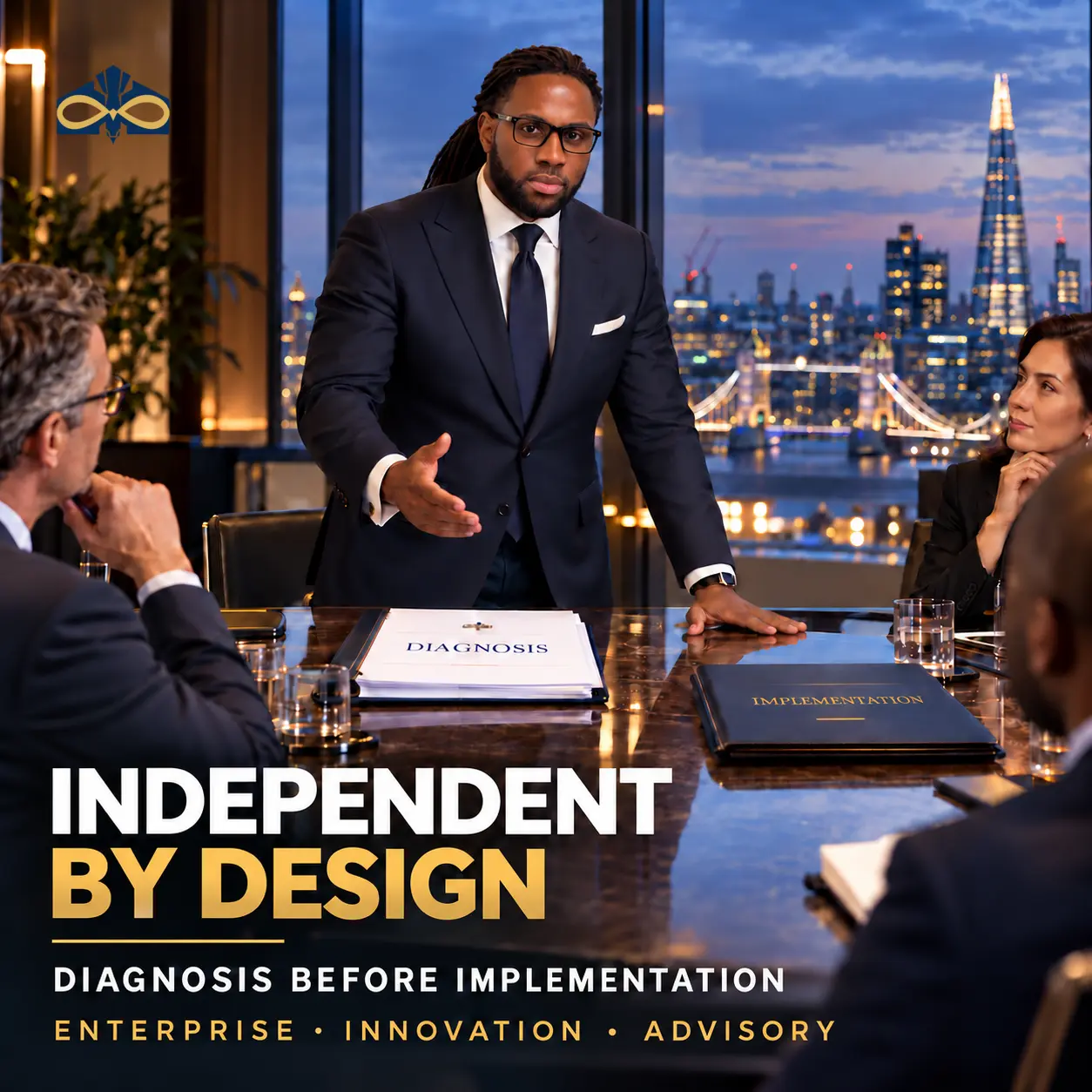
The independence of a transformation diagnosis becomes harder to demonstrate when its commercial success depends on securing the implementation that follows.
This becomes particularly important when leadership is approaching a consequential commitment but cannot yet distinguish ambition, reported progress and supplier confidence from evidence that the transformation can actually deliver.
The decision may affect investment, suppliers, operating structures, public commitments and the organisation's ability to achieve its strategic objectives. At that point, leadership needs more than reassurance. It needs an evidence-backed assessment of what is true, what remains uncertain and what should happen next.
The commercial tension inside transformation diagnosis
When the organisation conducting the diagnosis also expects to secure the implementation, an inherent tension can arise.
This does not mean that every combined advisory and implementation provider will produce a compromised recommendation. It means the commercial dependency should be recognised, disclosed and controlled rather than ignored.
A diagnosis should not begin with an assumed answer:
- The transformation must proceed.
- The programme requires recovery.
- A new operating model must be implemented.
- The technology must be replaced.
- The organisation needs a larger delivery partner.
- The diagnosing organisation should lead everything that follows.
Tawose Group's position
Tawose Group's Transformation Diagnosis & Delivery Design service is independent by design.
We begin with the consequential decision facing the organisation, not with a predetermined implementation proposition.
The diagnostic questions may include:
- Can the transformation achieve its intended outcome?
- Is the proposed delivery construct credible?
- Do ownership, capacity and decision rights match the commitment?
- Are material dependencies visible and controllable?
- Can the operational environment absorb the proposed change?
- Is the organisation ready to mobilise?
- What conditions must be satisfied before further exposure?
The recommendation is not predetermined
The evidence is tested against the intended outcome, delivery environment and consequences of making the wrong decision.
A valid diagnosis may recommend that the organisation:
- Proceed.
- Proceed with conditions.
- Restructure.
- Re-scope.
- Obtain further evidence.
- Reconsider or defer the commitment.
Independent services, commissioned by need
A defensible decision to stop, defer or reconsider is not a failed engagement. The evidence may equally demonstrate that the transformation is viable, the existing delivery structure is sufficient and no additional Tawose intervention is required.
Transformation Diagnosis & Delivery Design contains three independently commissionable components:
- DECIDE — Transformation Diagnosis: an evidence-backed assessment of viability, material constraints and the decision required next.
- DESIGN — Transformation Delivery Design: an executable delivery blueprint covering outcomes, ownership, governance, capacity, sequencing, dependencies and operational alignment.
- PROVE — Mobilisation Validation: an evidence-backed decision on whether the proposed delivery construct is ready to mobilise and under what conditions.
Diagnosis before implementation
These components may be commissioned separately or combined where the client's requirement justifies it. There is no mandatory sequence, forced bundle or automatic progression into implementation.
Implementation can remain with the client, its incumbent suppliers or its chosen delivery partners.
Tawose Group can support subsequent delivery where separately commissioned and appropriate. The diagnosis does not depend upon securing that mandate.
Practitioner-led independence
This approach is grounded in direct leadership across HMCTS national reform, multinational technology and operating-model transformation, complex supplier environments, delivery integration and operational transition.
That experience has involved bringing programmes, services, suppliers, product, design, engineering, platform operations, assurance, operational teams and adoption functions around shared outcomes.
Independent diagnosis is therefore not treated as a theoretical review. It must produce evidence that can support a consequential decision and, where required, an executable route forward.
Clear decision rights
Tawose Group retains professional independence over its findings and recommendations.
The client retains authority for the organisational decision, including whether to proceed, accept risk, commission further work or appoint an implementation provider.
Client agreement is not required for Tawose Group to reach an evidence-backed conclusion. Equally, a Tawose recommendation does not replace the client's accountability for its decision.
- Evidence from assumption.
- Professional judgement from organisational authority.
- Acceptance of a deliverable from agreement with its conclusion.
- Independent diagnosis from the commercial pursuit of implementation.
Why the distinction matters
Transformation leaders need confidence that a diagnostic intervention is testing the delivery proposition rather than constructing the justification for a predetermined sale.
The purpose is not to prove that a programme is broken. It is to establish what the evidence supports, what remains uncertain and what must be true for the transformation to succeed.
That is how uncertainty becomes evidence, evidence supports decision confidence and decision confidence enables executable delivery.
Start before assumptions become sunk cost
If your organisation is approaching a consequential commitment, mobilisation or redesign decision, talk to Tawose Group before assumptions become sunk cost.