Independent Diagnosis & Operating-Model Design
Why Delivery Challenges Keep Compounding
Independent diagnosis reveals how fragmented demand, decisions, capacity and dependencies combine to constrain delivery—and what leadership can do about it.
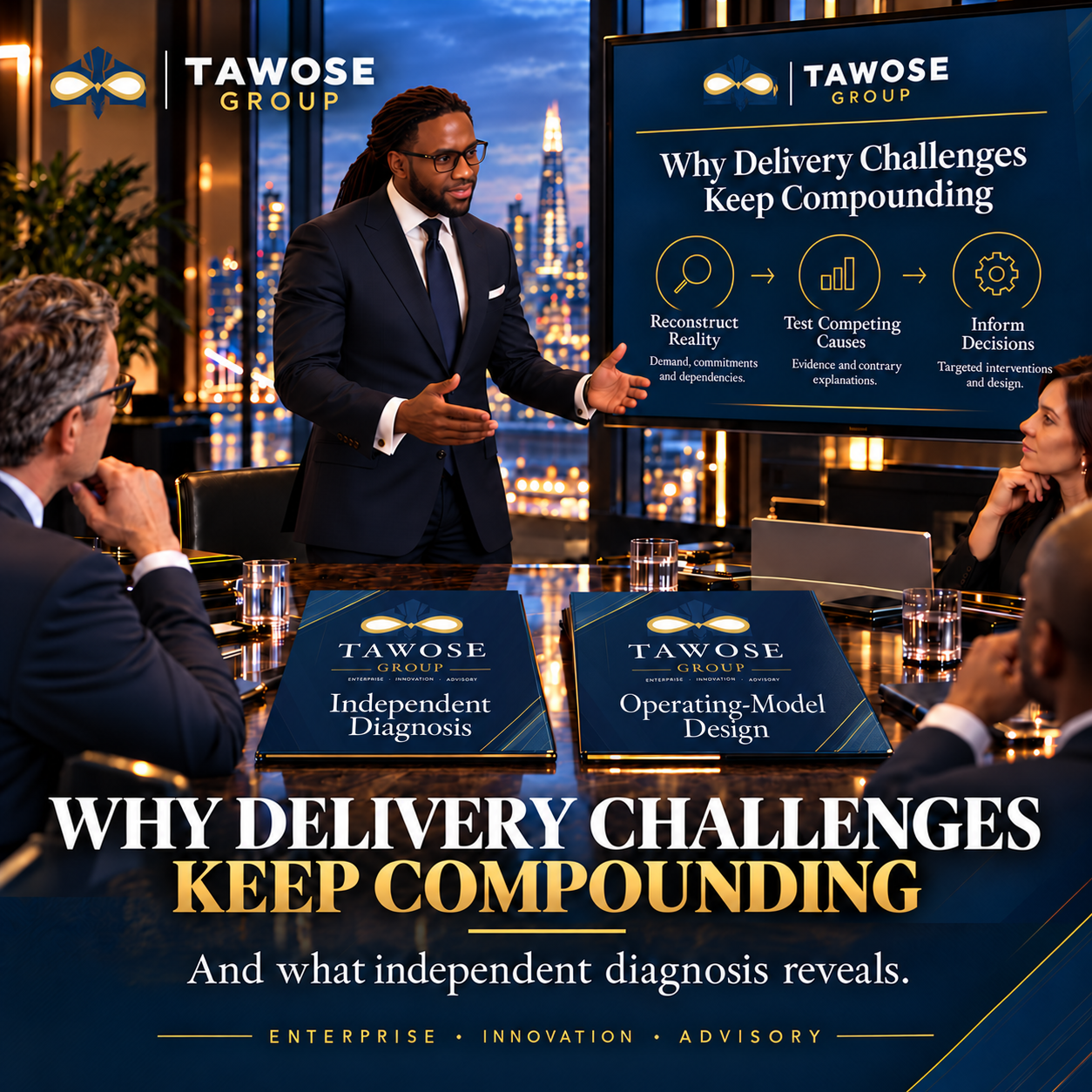
Organisations can have capable teams, approved plans and functioning governance while facing increasingly difficult delivery challenges. The problem is not necessarily inadequate effort or failing programmes. It is often that the demands placed upon the organisation are growing faster than its ability to reconcile priorities, make decisions and coordinate the resources on which delivery depends.
Citizen and business demand, operational incidents, regulatory obligations and planned service improvements arrive through different channels. They compete for specialists, platforms, suppliers, security, assurance and operational capacity. Each workstream can maintain a credible local plan while the combined commitments become difficult to honour.
The critical question is not simply whether individual teams are progressing. It is whether the organisation's connected operating environment can sustain the commitments being made.
The problem often lies between the parts
Operational service teams, organisational decision-makers and technology/change-delivery teams may each function effectively within their own boundaries. The difficulty emerges at their interfaces.
Demand may enter without a reconciled enterprise view. A programme may be approved before scarce capacity is allocated. Dependencies may be acknowledged without clear ownership. A release may be marked complete before the receiving service can safely adopt and support the change.
Additional reporting can make these tensions more visible without resolving them. Replanning can rearrange commitments without changing the underlying constraint. Requests for more resources may address a genuine shortfall—or conceal a problem in how demand, priorities and decisions are managed.
These are not interchangeable diagnoses. They require different responses.
Diagnose before prescribing
Tawose Group's Independent Diagnosis begins with a material executive decision, a bounded scope and a defined evidence base.
We reconstruct how real commitments are created and carried through the operating environment: from the originating demand, through prioritisation, approvals, capacity and supplier dependencies, to delivery, operational acceptance and benefits.
We then test competing explanations against the evidence. Where delivery repeatedly slips, we examine whether capacity is genuinely insufficient, whether priorities conflict, whether approvals arrive too late, whether external dependencies govern the pace, or whether decision authority is unclear. Contrary cases matter: where similar work succeeds, what conditions are different?
This approach distinguishes a visible symptom from a supported causal finding. It also records material uncertainty rather than presenting untested assumptions as established fact.
The purpose is to identify which constraints have the greatest consequences, how they reinforce one another and where leadership has practical leverage.
From causal findings to operating-model design
Independent diagnosis does not begin with the assumption that a new operating model is required.
Where the evidence identifies weaknesses in how the organisation works, those causal relationships inform the design of targeted improvements. The intervention may concern:
- Integrated visibility of service and delivery demand.
- Clearer priorities, ownership and decision rights.
- Capacity allocation across competing commitments.
- Cross-service handoffs and supplier dependencies.
- Operational acceptance, adoption and benefits accountability.
- Technology or legacy obligations where these are material constraints.
Sometimes the right response is a focused correction within the existing arrangement. Sometimes the findings justify a more substantial operating-model change. And sometimes the evidence supports retaining what already works.
The design follows the diagnosis—not the reverse.
Give leadership a decision, not just a report
A decision-grade diagnostic should establish what the evidence supports and what remains uncertain. It should show which commitments can credibly continue, which constraints require executive authority, and the consequences of preserving, changing, deferring or investigating particular options.
This is valuable precisely because the answer is not predetermined. A defensible recommendation may be to proceed, make a targeted intervention, redesign a specific interface, obtain further evidence or reconsider a commitment.
The client retains authority and accountability for the organisational decision. Tawose Group retains independence over its diagnostic judgement. Any subsequent design or delivery support must be separately justified and commissioned.
Understand what is constraining delivery
Compounding challenges deserve more than another layer of reporting or a generic prescription to work harder.
Tawose Group helps leadership understand what is constraining delivery, why the constraint persists and which actions the evidence justifies—across real service, organisational and technology-delivery conditions.
Explore a bounded independent delivery/transformation diagnostic today.